Your SOC monitors threats. But can it prove what it would detect?
Published: 24th November 2026

The NCSC is asking boards to look beyond security monitoring and demand evidence of their ability to detect relevant attacker behaviour. Here’s what that means for your SOC, your managed security provider and the questions you should be asking.
Most organisations with a Security Operations Centre (SOC) can tell you how many alerts were investigated last month, how quickly incidents were escalated and whether the service met its agreed response times. All useful information. But there is a more important question that those reports may never answer.
If an attacker used a technique your existing security rules were not designed to recognise, would your SOC know where to look?
That question sits at the heart of new guidance published by the National Cyber Security Centre (NCSC) on 17 November 2026.
The NCSC is encouraging boards to seek evidence that their defenders can investigate relevant attacker behaviours, identify gaps in visibility and detection, and demonstrate that those weaknesses are being addressed. Crucially, the guidance applies whether security operations are managed internally or delivered by a third-party provider. For organisations investing in Managed Detection & Response (MDR), it raises an important question about the value they should expect from their security service.
Why 24/7 monitoring is only part of the answer
Continuous monitoring is fundamental to effective cyber defence. When a suspicious event triggers a detection rule, the SOC can investigate, establish the context and take appropriate action. But the process depends on the organisation having the right data, detection logic and investigative capabilities in place. A SOC could process every alert perfectly and still miss an attacker using a technique that generates no alert.
This is an important distinction because traditional SOC performance measures largely describe what happens after suspicious activity has been recognised. Metrics such as mean time to detect, response time and incident resolution are useful, but they tell you relatively little about activity that never entered the investigation process. Consider a hypothetical organisation that receives excellent monthly reports from its managed security provider. Every incident has been addressed within its service-level agreement and there are no outstanding critical alerts. Everything looks reassuring. But suppose an attacker compromises a legitimate user account, accesses sensitive information through authorised applications and gradually expands their access.
If the relevant identity, application and cloud activity is unavailable to the SOC, or the detection logic does not recognise the suspicious sequence, the existing reporting could remain reassuring throughout.
This does not mean the SOC has failed to fulfil its agreed monitoring responsibilities. It suggests that the organisation needs to examine whether those responsibilities, and the visibility supporting them, adequately reflect its actual risks.
What is threat hunting, and why does the NCSC consider it important?
Threat hunting is a proactive investigation into potentially malicious activity that existing alerts may have missed.
Rather than waiting for a predefined detection to trigger, security analysts start with a hypothesis informed by threat intelligence, known attacker techniques or the organisation’s particular risk profile.
For example:
- Could an attacker use a compromised account to access information in an unusual way without triggering an alert?
- Can we investigate signs of credential theft or suspicious privilege escalation?
- Would we recognise attempts to move between systems using legitimate administrative tools?
- Do we have sufficient visibility to investigate suspicious activity across our cloud and on-premises environments?
The analyst then examines the available data to establish whether there is evidence supporting the hypothesis. An important part of this work involves understanding attacker tactics, techniques and procedures, commonly known as TTPs. Unlike individual malicious IP addresses or file hashes, which attackers can change quickly, behaviours such as credential theft, persistence and lateral movement can provide a more enduring basis for investigation.
The MITRE ATT&CK framework offers a useful common language for describing these techniques and relating them to detection and investigation capabilities.
However, threat hunting is only as effective as the information available to the analyst.
And that leads to the most commercially significant point in the NCSC’s guidance.
You cannot investigate activity you cannot see
Security teams often describe the number of endpoints protected, the volume of logs collected or the range of products feeding their SOC. These measures help establish the scope of monitoring, but they might not be able to establish whether the right activity can be investigated.
For example, an organisation might have excellent endpoint protection but limited visibility into identity activity, SaaS applications or communications between certain network segments. An attacker moving between those environments could leave evidence across several systems. Individually, the events might appear unremarkable. Analysed together, they could indicate suspicious behaviour.
This is where combining endpoint, identity, network and cloud information through Security Information & Event Management (SIEM) can become particularly valuable. Yet collecting more data is not automatically the right answer. A useful investigation depends on whether relevant events are recorded, retained for an appropriate period, accessible to analysts and sufficiently detailed to support meaningful conclusions.
An organisation can spend heavily on telemetry without establishing whether the resulting data is adequate for the investigations that matter most.
How can you prove your SOC’s detection capabilities are improving?
The NCSC recommends that boards look for evidence of relevant attacker techniques being investigated, the gaps identified, who owns them and what has been done to address them. Useful evidence to collect or request from your MSSP might include:
| Area | Evidence to request |
|---|---|
| Relevant attacker behaviours | Which techniques were prioritised, and why are they relevant to our organisation? |
| Investigation coverage | Which techniques can analysts meaningfully investigate using our existing data? |
| Visibility gaps | Which endpoints, identities, applications, networks or cloud services lack sufficient telemetry? |
| Detection improvements | Which detection rules or investigative procedures have been added, refined or retired? |
| Validation | Where have selected detections been safely tested, and what did those tests demonstrate? |
| Remediation | Who owns each significant gap, what action is agreed and when is it due? |
| Progress | What has changed since the previous review, and which risks remain unresolved? |
All the while, the detection capabilities must be proportionate to the organisation’s size, complexity and risk profile. A mid-market professional services firm may prioritise identity compromise, sensitive document access and cloud applications. A manufacturer may also need to consider production networks, operational technology (OT) and the boundaries between IT and industrial environments.
Some visibility gaps will be straightforward to address. Others may involve licensing, technical constraints, operational disruption, data retention costs or systems that cannot easily support modern monitoring.
Threat hunting and detection testing are complementary
There is an important technical limitation in how organisations interpret the results of threat hunting. A successful investigation demonstrates that analysts could search for and interpret relevant evidence using the data available at that time. It does not necessarily demonstrate that the SOC would automatically generate an alert if an attacker used the same technique tomorrow as that requires additional validation. For example, an organisation may have the logs necessary to investigate suspicious PowerShell activity after the event. To establish whether the activity would generate an alert, it would need to test the relevant detection under controlled conditions. Security testing, adversary emulation and carefully scoped purple-team exercises can help validate whether selected attacker behaviours are visible, whether detections trigger and whether the expected response follows.
An effective improvement cycle therefore looks like this:
Prioritise relevant attacker behaviour → Hunt for evidence → Identify gaps → Improve detections or visibility → Validate selected behaviours → Report progress.
There will always be limits to what can be tested. Results are specific to the conditions, systems and behaviours examined. Nevertheless, this approach produces more meaningful evidence than relying solely on the number of alerts handled or tools deployed.
What should you ask your managed security provider?
For an organisation already paying for MDR or a managed SOC, the NCSC’s guidance provides a useful starting point for the next service review.
Five questions are particularly revealing.
- How do you decide which attacker behaviours to hunt for in our environment?
Look for a connection between threat intelligence, your business risks and the systems you actually operate. A generic catalogue of techniques is a starting point, but prioritisation should reflect your organisation. - What have your investigations told us about our current visibility?
Ask for examples of investigations undertaken and any limitations discovered. These might relate to missing logs, inaccessible data, insufficient retention or gaps between security platforms. - What has changed because of those findings?
A mature process should connect findings to practical improvements, whether that means refining detection logic, integrating new telemetry or changing investigative procedures. - How do we know those changes have worked?
Distinguish between deploying a new rule, testing whether it triggers and demonstrating that the response process works as intended. Each provides a different level of evidence. - Can you show us which gaps remain open and who is responsible for closing them?
Some improvements will depend on your provider. Others may require action from your internal IT team, a cloud administrator or another technology supplier. The important thing is that the responsibility is explicit.
These questions are also useful when assessing a prospective provider. Ask how threat hunting is delivered, whether it is included in the proposed scope, how detection improvements are managed and what evidence customers receive. The NCSC makes clear that effective threat hunting does not necessarily require organisations to establish a separate internal team. Existing security capabilities and external providers may offer a practical way forward.
However, buyers should check the precise scope of any managed service rather than assume that all forms of threat hunting, detection engineering and validation are included.
Turning security monitoring into measurable improvement
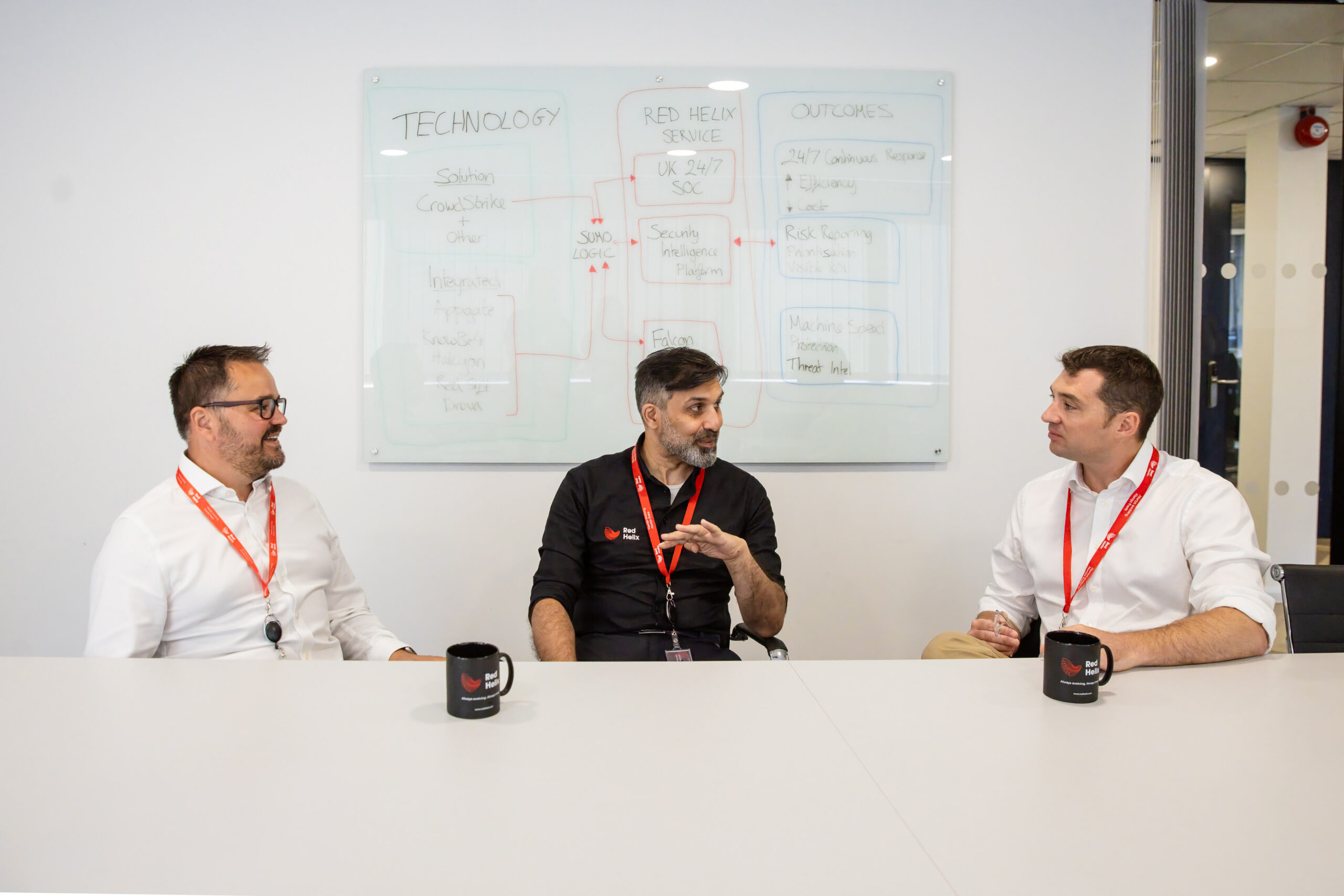
At Red Helix, our Managed Detection and Response services combine the expertise of our 24/7/365 UK Security Operations Centre with technologies including CrowdStrike, Sumo Logic and network detection capabilities.
This gives organisations access to specialist security monitoring, investigation, threat hunting and response, supported by information from relevant parts of their environment.
Our Security Intelligence Platform helps customers understand their security posture, SOC activity and progress against security improvements. Our wider governance and security testing expertise can also support organisations that need to examine particular risks or validate controls.
The combination matters because improving detection capability requires more than a good analyst or an effective technology platform in isolation. It requires the right information, relevant investigative expertise and a way to turn findings into action. The precise activities, validation requirements and reporting arrangements should be agreed according to each organisation’s needs and service scope.
Talk to Red Helix about your managed security service and explore how your existing coverage, visibility and reporting could be improved.